


What is a Canada PR Visa?
A Canada Permanent Resident Visa serves as a pathway to obtaining permanent residency in Canada. It is valid for a period of 5 years. Individuals holding a Canada PR card are allowed to live, study, and work anywhere in Canada without restrictions. Depending on their eligibility, they may also apply for Canadian citizenship.
Do’s and Don’ts of Canadian Permanent Residents:
| DOs | DON’Ts |
| 1. Canada PR holders receive most social benefits available to citizens, including access to healthcare.
|
1. PR holders are not allowed to vote or participate in political elections |
| 2. PR holders are free to live, work, or study in any part of Canada | 2. They cannot occupy certain government roles that require high-level security clearance |
| 3. They are eligible to apply for Canadian citizenship after meeting requirements | |
| 4. PR holders are protected under the Canadian Charter of Rights and Freedoms as well as Canadian law |
Can Indian Citizens Apply for Canada Permanent Residency?
Yes, Indian citizens can apply for and obtain permanent residency in Canada if they fulfill the required eligibility criteria. Canada PR (Permanent Residency) is an official status provided to immigrants, allowing them to live, work, and study anywhere across Canada. While PR status is not the same as Canadian citizenship, it grants many similar rights and benefits, except for certain limitations such as voting rights and eligibility for high-level government positions.
Difference Between Canada PR and Canadian Citizens
The comparison between Canada Permanent Residents and Canadian citizens is outlined below:
| Factor
|
Canada PR Holders | Canadian Citizens |
| Status | Granted permanent residency status | Hold full citizenship of Canada |
| Right to Vote | Not permitted to vote in elections | Eligible to vote in all elections |
| Political Participation | Cannot run for political office | Can contest elections and hold public office |
| Passport | Do not receive a Canadian passport | Eligible for a Canadian passport |
| Residency Requirement | Must maintain residency obligations | No residency requirement |
| Job Opportunities | Restricted from certain government roles | Can apply for all government jobs |
| Citizenship | Can apply for citizenship after eligibility | Already a citizen |
| Legal Rights | Protected under Canadian law | Fully protected with complete rights |
| Renewal of PR card | PR card renewed every 5 years | Citizenship is for lifetime |
Canada PR Process
The Canada PR process is a straightforward seven-step procedure for applicants who meet the eligibility criteria. Once you complete all seven steps, you can proceed with submitting your Canada PR visa application.
A Permanent Resident (PR) visa has become a popular choice among individuals planning to settle in Canada, often referred to as the ‘Maple Leaf country’. The process may vary depending on the pathway you choose to apply for Canada PR.
Below are the main pathways that guide applicants through the Canada PR process:
- Express Entry
- Provincial Nominee Program (PNP)
- Quebec Immigration
- Atlantic Immigration Program
- Canada Start-up Visa Program
Did You Know? You can obtain a Canada PR visa even without having a job offer in Canada.
Canada PR via Express Entry
Applicants applying for a Canada PR visa through the Express Entry program are required to go through a points-based selection system. The Express Entry system includes three main categories:
- Federal Skilled Worker Program (FSWP)
- Federal Skilled Trades Program (FSTP)
- Canadian Experience Class (CEC)
If you are a skilled professional residing outside Canada, you can apply for a Canada PR visa under the Federal Skilled Worker Program.
Canada PR via a Provincial Nominee Program
Canada provides nearly 80 different Provincial Nominee Programs (PNPs), each having its own set of eligibility criteria. These programs enable provinces to address labour shortages and select candidates for in-demand occupations.
Most PNP streams require applicants to have a connection with the province, such as work experience, education, or a job offer. However, there are certain PNPs that do not require any prior connection, allowing applicants to apply directly.
Some of the well-known PNP programs for Canada PR include:
- Saskatchewan PNP
- Manitoba PNP
- Alberta PNP
- Ontario PNP
- New Brunswick PNP
- Nova Scotia PNP
- Prince Edward Island PNP
- British Columbia PNP
Market Background & Trends
- Immigration Target: Over 500,000 new immigrants are welcomed each year.
- High-Demand Sectors: Technology, healthcare, education, and skilled trades.
- Aging Population: Increasing need for younger skilled professionals.
- Key Pathways: Major routes include Express Entry and PNPs.
- Focus on Diversity: Promoting diverse immigration to support growth.
- Digital Processing: Online applications have made the process more efficient.
- Population Growth: Around 75% of growth comes through immigration.
- Express Entry Processing Time: Approximately 6 months.
- PNP Invitations: Numbers are increasing every year.
Job Demands in Canada for Indians
According to StatCan, there are over 1 million job opportunities in Canada available for skilled professionals from overseas. The table below highlights some of the most in-demand occupations along with their average annual salaries.
| Occupation | NOC Code | Average Annual Salary (CAD) |
| Mechanical Engineers | 21301 | 85,000 – 100,000 |
| Civil Engineers | 21300 | 80,000 – 95,000 |
| Biomedical Engineers | 21399 | 75,000 – 95,000 |
| Chemical Engineers | 21320 | 85,000 – 110,000 |
| Electrical & Electronics Technologists | 22310 | 65,000 – 85,000 |
| Software Engineers/Developers | 21231 | 90,000 – 120,000 |
| Data Analysts/Scientists | 21223 | 80,000 – 110,000 |
| Cybersecurity Specialists | 21220 | 95,000 – 130,000 |
| Web Developers | 21234 | 70,000 – 95,000 |
| Veterinarians | 31103 | 90,000 – 120,000 |
| Pharmacists | 31120 | 95,000 – 120,000 |
| Physiotherapists | 31202 | 75,000 – 95,000 |
| Medical Sonographers | 32122 | 70,000 – 90,000 |
| Construction Managers | 70010 | 85,000 – 115,000 |
| Electricians | 72200 | 60,000 – 85,000 |
| Accountants | 11100 | 65,000 – 90,000 |
| Registered Nurses | 31301 | 75,000 – 95,000 |
| Specialists in Surgery/Medicine | 31100, 31101 | 150,000 – 300,000 |
Benefits of Permanent Residency in Canada
- Good Career Opportunities: High demand for jobs with competitive salaries.
- Better Quality of Life: Safe country with free healthcare facilities.
- Excellent Education: Good schooling options for children.
- Welcoming Society: Friendly and multicultural environment.
- Multiple PR Pathways: Options like Express Entry and PNP.
- Work-Life Balance: Fixed working hours and paid leaves.
Canada PR Eligibility
- Age: 18–45 years gives maximum points.
- Education: Higher qualifications improve your chances.
- Work Experience: Minimum 1 year of skilled work in the last 10 years.
- Language Skills: CLB 7+ in IELTS/CELPIP or French exams.
- Proof of Funds: As required under CRS guidelines.
- Adaptability: Based on spouse profile, relatives, or Canadian experience.
- Job Offer (Optional): Can increase your score.
Medical & Security: Must clear medical and background checks.
Canada PR Eligibility Points Calculator
| Factor | Criteria (Simple Guide) | Max Points |
| Age | 18–35 = 12, after 35 → -1/year, 46+ = 0 | 12 |
| Education | PhD (25), Master’s (23), Bachelor’s (21), Diploma (15–19) | 25 |
| Work Experience | 1 yr (9), 2–3 yrs (11), 4–5 yrs (13), 6+ yrs (15) | 15 |
| Language | IELTS CLB 7–9+ (higher score = more points) | 28 |
| Job Offer | Valid job offer = 10 | 10 |
| Adaptability | Spouse IELTS, relative, Canada exp | 10 |
| Total | 100 | |
ECA – Educational Credential Assessment
One important step while applying for a Canada PR visa is getting an Educational Credential Assessment (ECA) if your education is completed outside Canada. The ECA report confirms that your qualifications are equal to Canadian secondary or higher education standards.
ECA is required under Express Entry to prove that your foreign education is valid and comparable to a Canadian qualification.
Who needs an ECA?
- Applicants who completed their education outside Canada under the Federal Skilled Worker Program.
- Candidates who want to claim points for education obtained outside Canada.
- Spouse or partner (if included) also needs an ECA to claim additional points.
- In most cases, only the highest qualification needs to be assessed. If you are claiming points for “two or more credentials,” then both must be evaluated.
Designated ECA Organizations
- World Education Services (WES)
- Comparative Education Service – University of Toronto School of Continuing Studies
- International Credential Assessment Service of Canada (ICAS)
- International Qualifications Assessment Service (IQAS)
- International Credential Evaluation Service (ICES)
- Medical Council of Canada (for Doctors)
- Pharmacy Examining Board of Canada (for Pharmacists)
IRCC accepts ECA reports that are issued on or after the official designation date for immigration purposes.
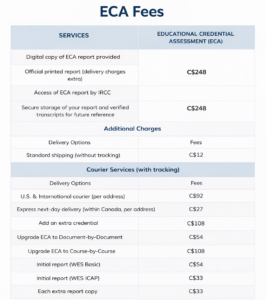
Choose the organization based on occupation.
Total cost required for Canada PR from India:
The total cost for a Canada PR visa generally ranges between 2,500 CAD to 3,000 CAD, depending on the number of applicants.
- Single applicant: 2,340 CAD
- Couple (no children): 4,680 CAD
- Couple with one child: 5,285 CAD
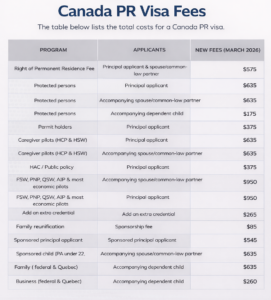
This cost includes application fees (for applicants and dependents), medical examination, English language test, ECA (Educational Credential Assessment), and PCC.
The table below provides a detailed breakdown of the total expenses for a Canada PR visa.
Proof of Funds for Canada PR
Proof of Funds is an important requirement for Canada PR applicants under the Express Entry system. It is used to show that you have sufficient financial resources to support yourself and your family after arriving in Canada.
Applicants must demonstrate that they can manage their basic living expenses such as housing, food, transportation, and other daily needs.
The required fund amount depends on the total number of family members included in the application. These funds should be readily available, legally accessible, and maintained in your bank account.
In some cases, even applicants under certain categories like Canadian Experience Class (CEC) or those with a job offer may be asked to provide proof of funds or financial documents, depending on their profile or additional document requests from IRCC.
This table shows the minimum amount you need to immigrate to Canada. If you have more money, you should list the full amount in your profile or application.
| Number of Family Members | Funds you need (CAD) Updated July 7, 2025 |
| 1 | $15,263 |
| 2 | $19,001 |
| 3 | $23,360 |
| 4 | $28,362 |
| 5 | $32,168 |
| 6 | $36,280 |
| 7 | $40,392 |
| If more than 7 people, for each additional family member | $4,112 |
What is Accepted as Proof of Funds
Your funds must be available at two stages:
- When you apply
- When your PR visa is issued
Bank Letter Requirement
You must provide an official letter from your bank or financial institution where your accounts are held.
The letter should include:
- Bank contact details (address, phone, email)
- Your name
- Details of any debts (loans, credit cards)
- Account details, including:
- Account numbers
- Date of opening
- Current balance
- Average balance for the last 6 months
Access to Funds
You must show that you have full legal access to the funds.
- Funds cannot be based on property or borrowed money
- You must be able to use this money for living expenses in Canada
- If your spouse is accompanying you, joint account funds can be included
- If funds are in your spouse’s account, you must prove access to them
What is Canada PR Processing Time?
The Canada PR process involves multiple stages, and the overall processing time depends on factors such as the immigration program, completeness of documents, and other aspects like application volume and the applicant’s country of origin. The Express Entry system is one of the quickest pathways for Canada PR, usually taking less than 6 months.
Processing Time by Immigration Program
The timeline varies based on the program you apply under. Below is an overview of common programs and their average processing times:
| Canada PR Programs | Categories | Average Processing Time |
| Express Entry Program | Federal Skilled Worker Program | 6 months |
| Canadian Experience Class | 5–6 months | |
| Federal Skilled Trades Program | 6 months | |
| Provincial Nominee Program (PNP) | Express Entry PNPs | 6 months |
| Non-Express Entry PNPs | 12–19 months | |
| Family Sponsorship | Spouse visa | 10–12 months |
| Dependent children visa | 9–12 months | |
| Parents & Grandparents visa | 24 months | |
| Atlantic Immigration Program | Atlantic High-Skilled Program | 6–12 months |
| Atlantic Intermediate Skilled Program | 6–12 months | |
| Atlantic International Graduate Program | 6–12 months | |
| Startup Visa Program | N/A | 12–16 months |
| Quebec Skilled Workers Program | N/A | 12–16 months |
| Humanitarian or Refugee Program | N/A | 12–36 months |
Tips to Reduce PR Processing Time
- Prepare all required documents in advance
- Ensure all information submitted is accurate and complete
- Regularly check IRCC updates and respond to requests quickly
- Choose faster pathways where applicable (like Express Entry)
- Take professional guidance to avoid errors and delays
Frequently Asked Questions
The easiest pathway is usually Express Entry, especially under the Federal Skilled Worker Program or Canadian Experience Class, depending on your profile. You can apply online through Express Entry by creating a profile, submitting documents, and waiting for an Invitation to Apply (ITA). You need factors like age, education, work experience, language score (IELTS/PTE), and proof of funds. It is recommended to choose experienced and genuine consultants who provide transparent process guidance and documentation support. Express Entry is generally the most affordable option as it has lower processing costs compared to other programs. Canada uses a points-based system (CRS) based on age, education, work experience, language skills, and adaptability. Can someone explain the Canada PR process step by step? Express Entry applications are usually processed within 6–8 months. Main pathways include Express Entry, PNP, Family Sponsorship, and Business programs, each with different eligibility and timelines. You do not need to stay in Canada before PR. You can apply directly from outside Canada. It typically takes 6 months (Express Entry) to 12–24 months (other programs). Minimum CLB 7 (around IELTS 6 bands) is required, but higher scores improve chances. There is no strict age limit, but 18–45 years gives maximum points Funds depend on family size, usually starting from around CAD 13,000+ for a single applicant. It usually ranges between CAD 2,500 to CAD 3,000, depending on applicants. Yes, Indians can apply and are among the highest number of PR applicants in Canada. PR status is valid for 5 years, after which it must be renewed. How can I apply for Canada PR? Minimum 67 points (FSWP) and competitive CRS score (usually 470+). Minimum 6 bands, but 7+ bands increase selection chances. Eligibility check → IELTS → ECA → Profile submission → ITA → Application → Approval. It allows parents and grandparents to stay in Canada for up to 5 years per visit. No, sponsorship is limited to eligible family members only. PR visa is typically valid for 5 years. PNPs are increasing invitations and targeting specific occupations based on labour demand. ECA means Educational Credential Assessment. Yes, ECA must be from an IRCC-approved organization. Yes, ECA details are required to claim education points. From organizations like WES, IQAS, ICAS, CES, ICES. WES, IQAS, ICAS, CES, ICES, MCC, and PEBC From the Medical Council of Canada (MCC) Yes, alternative documents may be accepted depending on the institution. Yes, if sent through approved channels and formats. It is usually the year mentioned on your final certificate. Usually only the highest qualification is required, unless claiming multiple credentials. Documents must be sent directly by the institution or via approved methods. You should contact WES or your institution to re-initiate verification. You can upgrade or request an ECA version of your report. Typically 20–30 working days after document submission. Yes, but evaluation depends on program and mode of study. Through official university transcripts sent directly to WES. Around CAD 850–1365 per applicant (excluding other costs). PNP fees vary by province, generally CAD 250–1500. India receives the highest number of PR approvals. Providing false documents, incomplete details, or misrepresentation. Ontario, British Columbia, and Alberta are major job markets. IT, healthcare, engineering, and skilled trades. Only if you are applying under French language category or want extra points. PR allows living and working, while citizenship includes voting rights and passport. Yes, especially through Express Entry. No, only citizens can get a passport Provinces like Saskatchewan, Alberta, and Nova Scotia are considered easier under PNP. What is the simplest way to get permanent residency in Canada currently?
How can I apply for Canada PR while living outside Canada?
What are the basic eligibility requirements for Canada PR?
Which immigration consultants are best for Canada PR applications?
What is the most cost-effective way to obtain Canada PR?
What criteria does Canada use to select skilled workers for PR?
Can someone explain the Canada PR process step by step?
What is the average time to receive Canada PR after applying?
What are the different Canada PR pathways and how do they differ?
How many years do you need to stay in Canada to get PR?
How long does it take to obtain Canada PR?
What IELTS score is required for Canada PR?
What is the age requirement for Canada PR?
How much proof of funds is needed for Canada PR?
What is the total cost of Canada PR from India?
Can Indian citizens apply for Canada PR?
What is the validity duration of Canada PR?
How can I apply for Canada PR?
How many points are required for Canada PR eligibility?
What IELTS band score is needed to apply for Canada PR?
What is the process to get a Canada PR visa?
What is a Canada Super Visa?
Can a Canadian citizen sponsor someone outside their family?
What is the validity period of a Canada PR visa?
What are the latest updates on Canada PNP?
What does ECA stand for?
Do I need a specific type of ECA for Canada immigration?
Is it necessary to mention ECA details in the Express Entry profile?
Where can I obtain an ECA report for Canada immigration?
Which organizations are approved by IRCC to issue ECA reports?
Where should physicians get their ECA done from?
Can I get an ECA if my course did not provide mark sheets?
Does WES accept documents sent through Docs Wallet?
What is considered the “year of award” in ECA?
Do I need to submit both Bachelor’s and Master’s degrees for ECA?
How should documents be sent to WES?
What if my institution has not received the verification email from WES?
What should I do if I already have a WES report and need ECA for immigration?
How much time does WES take to complete an evaluation?
Does WES evaluate degrees from Sikkim Manipal University?
How can Gujarat Technological University students send documents to WES?
What is the application fee for Express Entry?
What are the fees for Provincial Nominee Program (PNP)?
Which country receives the highest number of Canada PR approvals?
What actions can lead to a Canada PR application being rejected?
What are the top job markets in Canada?
Which occupations are currently in demand in Canada?
Is the TEF exam required for Canada immigration?
What is the difference between Canada PR and Canadian citizenship?
Can you get Canada PR without a job offer?
Can PR holders apply for a Canadian passport?
Which province in Canada offers easier PR options?